10 Games Like What Remains of Edith Finch to Play Next
Explore 10 narrative games with family mysteries, environmental storytelling, intimate characters, and inventive first-person exploration.
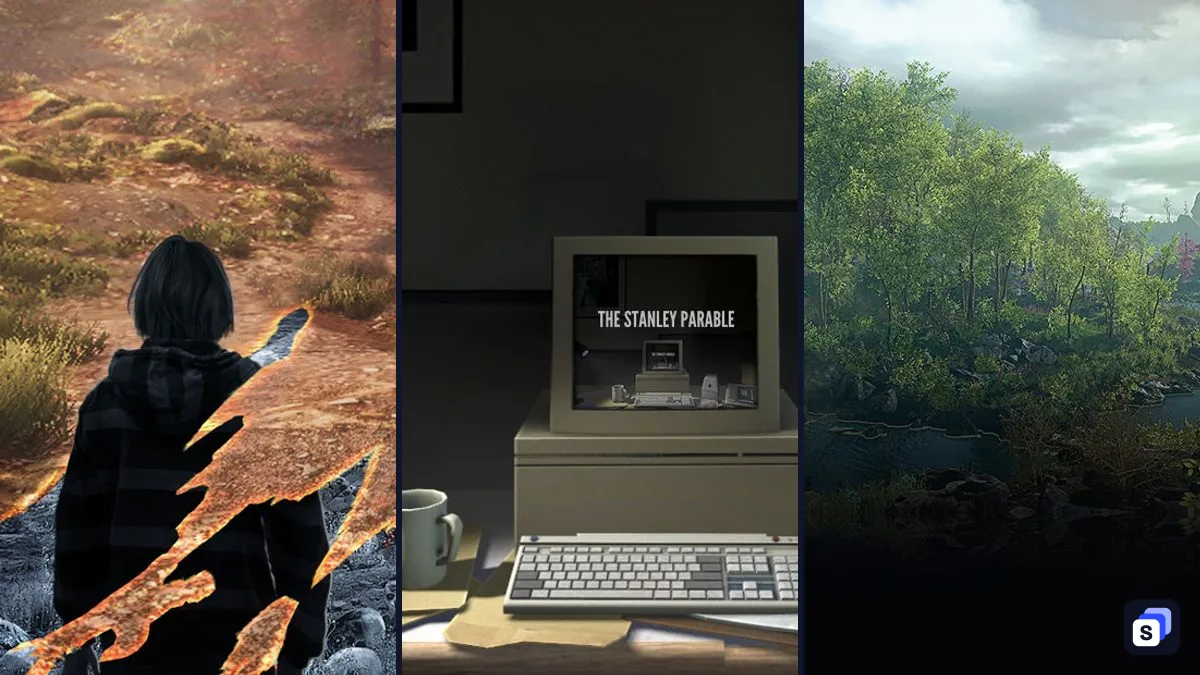
What Remains of Edith Finch turns a colossal Washington family house into a collection of strange, playable tales about memory and loss. These 10 alternatives preserve its strongest qualities: intimate mysteries, places that reveal character, and storytelling carried by exploration rather than constant action. Gone Home is the closest match because its empty family home makes ordinary rooms and belongings the evidence behind a personal story.
What makes What Remains of Edith Finch worth replacing
A convincing alternative needs more than a first-person camera. The strongest matches let a house, wilderness, island, town, or memory hold the story, then ask the player to connect scattered details about absent people; for a broader selection built around narrative craft, see these story-driven games.
The picks at a glance
| Game | What it shares with What Remains of Edith Finch | Main difference | Modes |
|---|---|---|---|
| Gone Home | A family mystery reconstructed inside an empty house | One continuous domestic investigation rather than separate tales | Single-player |
| Firewatch | First-person exploration tied to a personal mystery | A radio relationship drives the story across a wilderness | Single-player |
| The Vanishing of Ethan Carter | An atmospheric search for a missing person | Detective investigation and supernatural clues take priority | Single-player |
| Oxenfree | A personal supernatural mystery shaped by place | Dialogue choices affect relationships and the story | Single-player |
| Night in the Woods | Loss, belonging, and unsettling secrets | A populated 2D town replaces an empty first-person house | Single-player |
| The Stanley Parable | First-person storytelling that changes how scenes are understood | Satire, narration, and branching endings replace family tragedy | Single-player |
| The Beginner’s Guide | Intimate storytelling through explored spaces | Unfinished game levels frame a story about creative interpretation | Single-player |
| To the Moon | A life reconstructed through fragmented memories | Pixel-art memory travel replaces first-person environmental exploration | Single-player |
| Eastshade | Peaceful exploration reveals places and personal stories | Painting, quests, and an open island create a less linear journey | Single-player |
| SCP: Secret Files | Separate playable stories use different situations and tones | Paranormal case files bring more overt horror and puzzles | Single-player |
Gone Home
Gone Home is a first-person story exploration game that begins when you return after a year abroad and find the family house empty. Drawers, closets, letters, photographs, and the arrangement of rooms provide the trail, so progress comes from noticing what the Greenbriar family left behind rather than defeating enemies.
That domestic method makes it the nearest alternative to Edith’s search through the Finch house. Both games turn private spaces into records of family relationships and let discoveries change the meaning of rooms already visited. Gone Home differs by concentrating on one connected household mystery instead of moving through a collection of mechanically distinct family tales. The narrower structure keeps attention on a single absence and the personal evidence surrounding it, making this the natural next stop for anyone who wants another quiet house to investigate.
Firewatch
A remote Wyoming wilderness replaces the Finch residence in Firewatch, a first-person mystery built around a fire lookout and a handheld radio. The voice at the other end is the protagonist’s only emotional connection, so conversation accompanies the search through trails, lookout points, and isolated structures.
Firewatch shares Edith Finch’s deliberate exploration and its use of a detailed environment to sustain a personal mystery. Its major difference is that an ongoing relationship, rather than stories about absent relatives, gives each discovery its immediate context. The open wilderness also produces a wider sense of distance and isolation than the tightly layered Finch house. Start here if the reflective pace matters as much as the family theme, especially when dialogue sounds more appealing than a sequence of self-contained vignettes.
The Vanishing of Ethan Carter
The Vanishing of Ethan Carter is a first-person, story-driven mystery centered on the disappearance of a boy. Its valley invites close examination of objects, crime scenes, buildings, riverbanks, and forest clearings, with supernatural elements complicating the investigation.
Like Edith Finch, it expects the player to read a place and assemble a tragic account from fragments rather than follow a constant stream of objectives. The difference is the detective emphasis: clues and reconstructed events make observation part of an explicit investigation, while Edith’s family stories shift into bespoke playable scenes. That structure gives the mystery a more forensic edge without abandoning atmosphere. It fits readers who want environmental storytelling to demand deduction and who are comfortable with darker horror around the central disappearance.
Oxenfree
On an island party that goes wrong, Oxenfree follows Alex, her new stepbrother Jonas, and their friends after they open a ghostly rift. Exploration is tied to a live conversation system, and dialogue choices alter relationships while the supernatural mystery develops around the group.
The island functions much like the Finch house: its locations hold a buried history that gradually reframes what the characters are experiencing. Oxenfree’s defining departure is agency in conversation. Edith Finch presents fixed family accounts, whereas Alex’s responses can redirect social tension and affect how the night unfolds. The side-on presentation also creates distance from Edith’s first-person intimacy, but the focus on grief, memory, and place remains recognizable. Choose it when a responsive cast and several possible outcomes matter more than solitary exploration.
Night in the Woods
Returning home drives Night in the Woods, an exploration-focused adventure set among the inhabitants of a small town. Mae reconnects with friends, moves through familiar streets, and encounters an unsettling mystery while everyday conversations reveal how people and places have changed.
Its link to Edith Finch comes from the attention paid to home, personal history, loss, and details that make an ordinary setting carry emotional weight. The crucial difference is social density. Instead of entering rooms left behind by absent relatives, Mae repeatedly speaks with townspeople and participates in daily activities, so character development happens in the present rather than through recovered family episodes. The stylized 2D world and dark humor further soften the visual realism without removing the melancholy. It rewards players who want a longer return-home story built around relationships and a living community.
The Stanley Parable
The Stanley Parable places Stanley in an office after everyone else has disappeared, then uses a narrator to react to the paths the player takes. Doors, corridors, instructions, and refusals create branching routes and multiple endings, making the act of following a story part of the subject.
The shared ground with Edith Finch is formal invention. Both use first-person movement to deliver scenes that cannot be separated cleanly from player interaction, and both make familiar interiors feel increasingly strange. The Stanley Parable trades family history and grief for comedy, satire, and arguments about choice. Repetition is also intentional because alternate routes expose new responses from the narrator. It is the right detour for players most interested in Edith Finch’s changing interactive forms, provided they want those experiments aimed at storytelling conventions rather than emotional biography.
The Beginner’s Guide
A narrated tour through unfinished game levels forms The Beginner’s Guide. There are no traditional goals or objectives; instead, movement through disconnected spaces supports a story about a person struggling with something the narrator cannot fully understand.
That progression resembles Edith Finch’s movement between distinct family tales, since each environment introduces a new idea, mood, or way of interpreting its absent creator. The important difference is perspective: The Beginner’s Guide examines how someone assigns meaning to another person’s work, not how a surviving relative pieces together an inherited family past. Its compact length and minimal mechanics keep scrutiny on the narrator’s framing of every level. This alternative suits players drawn to introspection and structural experimentation, although its abstract spaces offer less of the tangible domestic history found in the Finch house.
To the Moon
To the Moon follows two doctors moving backward through a dying man’s memories to fulfill his last wish. Each visited moment adds context to his relationships, regrets, and desire to reach the moon, making recollection the route through an entire life.
The memory structure provides its strongest connection to Edith Finch. Both reveal a person through selected moments rather than a straightforward biography, allowing later discoveries to change the meaning of earlier scenes. To the Moon differs in presentation and interaction: pixel-art environments, dialogue, and a guided backward journey replace first-person investigation inside a physical family home. That makes it less about searching every corner and more about watching a carefully ordered emotional account come together. It belongs near the top of the list for readers who value the theme of remembered lives above Edith Finch’s particular exploration mechanics.
Eastshade
In Eastshade, a traveling painter explores an island, captures locations on canvas, talks with inhabitants, and helps people through quests. Cities, summits, forgotten sites, forests, and lakes make observation useful, while the easel turns scenery into a practical part of progression.
Eastshade shares Edith Finch’s low-pressure curiosity and belief that a place can carry stories worth stopping to examine. Its difference is tone and scope: this is an open island with residents to meet and paintings to create, not a concentrated family mystery inside a house. The broader structure gives players more freedom to choose where to go and whom to help, while its creative task replaces Edith’s sequence of tragic vignettes. It works best as a gentler alternative for anyone who wants first-person discovery and human stories without keeping grief or horror at the center.
SCP: Secret Files
SCP: Secret Files is a collection of paranormal cases connected to the SCP Foundation and an assistant researcher’s induction under Dr. Raymond Hamm. Separate files shift the situation around dangerous anomalies, using exploration, mystery, puzzles, and psychological horror to present different incidents.
Its anthology design is the closest structural echo of Edith Finch on this list. Each case can establish its own scenario and tone, much as the Finch family accounts use distinct playable forms while contributing to a larger frame. SCP: Secret Files differs through institutional case records and overt paranormal threats, replacing one family’s history with an organization devoted to containing anomalies. That change produces more direct horror and puzzle pressure than the reflective Finch house. Save it for when the appeal of switching between self-contained stories outweighs the need for a grounded domestic setting.
How we chose these games
Each pick connects to What Remains of Edith Finch through a specific feature: environmental clues inside a meaningful place, fragmented accounts of absent people, first-person mystery, inventive narrative interaction, or an anthology-like structure. The list favors games where that relationship changes how the story is discovered, while the differences cover dialogue, deduction, branching narration, memory travel, peaceful painting, and paranormal casework.
Questions
What is the best game like What Remains of Edith Finch?
Gone Home is the closest overall match because an empty family house, personal belongings, and hidden documents turn domestic exploration into the central mystery.
Which game like What Remains of Edith Finch has the strongest dialogue?
Firewatch puts a radio relationship at the center of its Wyoming mystery, while Oxenfree lets conversations and choices shape relationships during a supernatural island crisis.
Are these games focused on story rather than combat?
Yes, most of these picks emphasize exploration, dialogue, puzzles, or environmental clues. SCP: Secret Files adds paranormal danger, but its case-based narrative remains the main connection.
Which alternative uses memories as its main storytelling device?
To the Moon follows two doctors moving backward through a dying man's memories. Its pixel presentation differs sharply from Edith Finch, but both build a life story from fragmented personal moments.

Guides written and checked by the SuperDuperBundle team against our own price data and the stores' published policies.